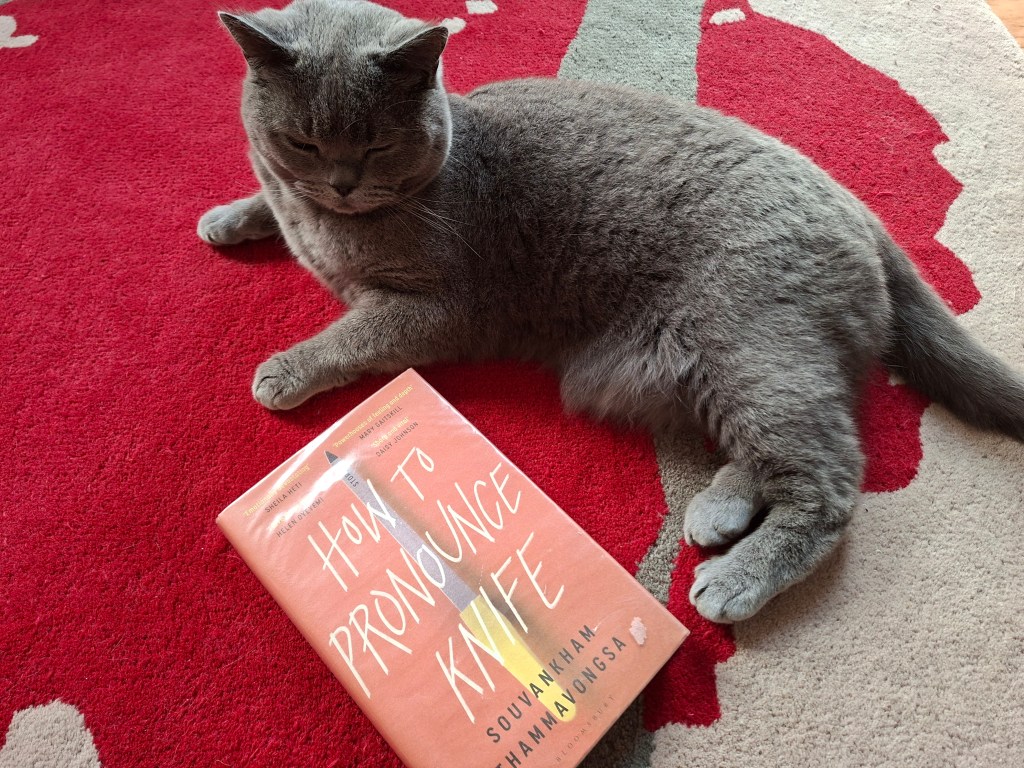
How to Pronounce Knife
Souvankham Thammavongsa
This book re-ignited the classificatory dilemma I had at the start of my ‘Read Around the World Challenge’. I found it on a list of books ‘from Thailand’. However, as I began to read, I discovered that this is a book of short stories about the experiences of Lao refugees. I wondered, then, what its supposed link to Thailand was. It turns out Thammavongsawas born in a refugee camp in Thailand to which her parents had fled from Laos. She moved to Canada when she was a year old. On this basis, I’m not sure I can count it as my book from Thailand.
I’m not too upset, though. Had How to Pronounce Knife not been dubiously classed as a Thai book, I wouldn’t have read it (at least not at this moment in time). And that would have been a shame, because I liked it very much.
It’s a book of short stories and I admit I often feel as though I don’t read short story collections well. I tend to approach them as I would a novel, moving straight from one story to the next as I would from one chapter to another. This can prove quite jarring, particularly when the stories are very different. On this occasion, because the stories are linked by the common theme of Laotian emigration, it wasn’t so bad. Still, I felt as though I probably ought to have sat and reflected at least for a moment at the end of each story, to give it its due. But I didn’t. I’m too impatient.
Because I knew I would be writing this account I did, however, make a note, as I went along of the stories I liked the best. The ones that stood out to me were the ones about language and the estrangement one can feel when living in a country that does not speak one’s native tongue. My very favourite was ‘Edge of the World’. At one point in this story, a woman is talking to her daughter in Lao; a second woman, also a Lao refugee, comes up to them and admonishes them, telling the mother she should speak to her daughter in English because, if she does not, “how else is she going to fit in when she starts school?!” The mother and daughter “laughed at her, how worried sick she seemed about not fitting in with everybody, as if that was a thing to want”. Just after this moment of defiance, the mother sends the child off to play with the other children. They are playing “it”. The child, who does not know the game, is utterly bewildered; she eventually gives up.
I found the subtle juxtaposition of these two moments quietly devastating. They also, to me, capture the power of this collection. In these stories, individual moments are described with restraint; yet these understated moments coalesce in a way that I found striking, nuanced and moving.


Leave a comment