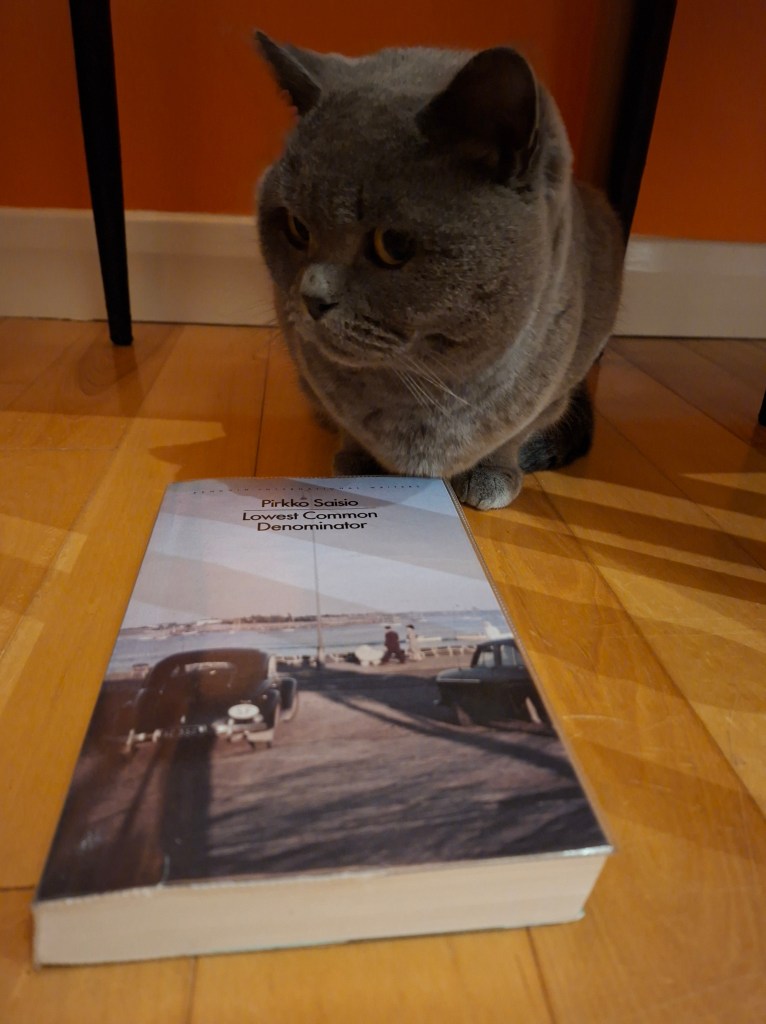
Lowest Common Denominator
Pirkko Saisio
I requested this book from my local library, having spotted it as a recommendation in The Guardian’s translated fiction section. When I went to collect it, I felt an unusual sense of dismay. It’s been a while since I’ve seen a book with a cover as uninspiring as this one. It didn’t make me want to start reading at all. Fortunately, I had nothing else to peruse, so I got stuck in.
And it turned out to be a wonderful book. It narrates the life of a child (the novelist herself, according to the blurb) growing up in 1950s Finland and brilliantly captures the child’s perspective. I loved the way it depicted both the vertiginous nature of childhood thought (at one point the narrator encounters ‘the thing she fears: the end of time’ and ‘feels herself falling away from time and space into an abyss that has no contours because it is boundless’) and its innocent profundity (when the narrator’s teachers tell her that Jesus ‘loves the sheep that’s deliberately lost more than the hundred others’, she wonders why there are ‘so many rules, and why [teachers are] so strict about breaking them, when breaking the rules is valued above following them?’).
Of all the things that perplex the narrator, her gender troubles her the most. She is ‘furious at her mother from preventing her from being strong and carefree and indifferent and a boy’. The novel captures her sense that she was ‘split in two’ through the alternating use of first- and third-person narration. This, I admit, was disconcerting at first, but ultimately struck me as a clever way to capture her discomfort, as well as to signal a shift from the child’s perspective to the point of view of her adult self.
The book’s narrator dreams vividly and her imagination is lively; this generates passages that are fantastical and mysterious. Ultimately, the novel records her journey to becoming a writer. I loved the moment when, having read her first book, she wonders:
Why do certain people get to imagine little girls who don’t really exist?
Who gets to, and why?
Who does?
Who?
Do I? A touching, subtle and astute novel. Having finished it I learnt it was the first in a trilogy; I’d read the next one without hesitation.


Leave a Reply