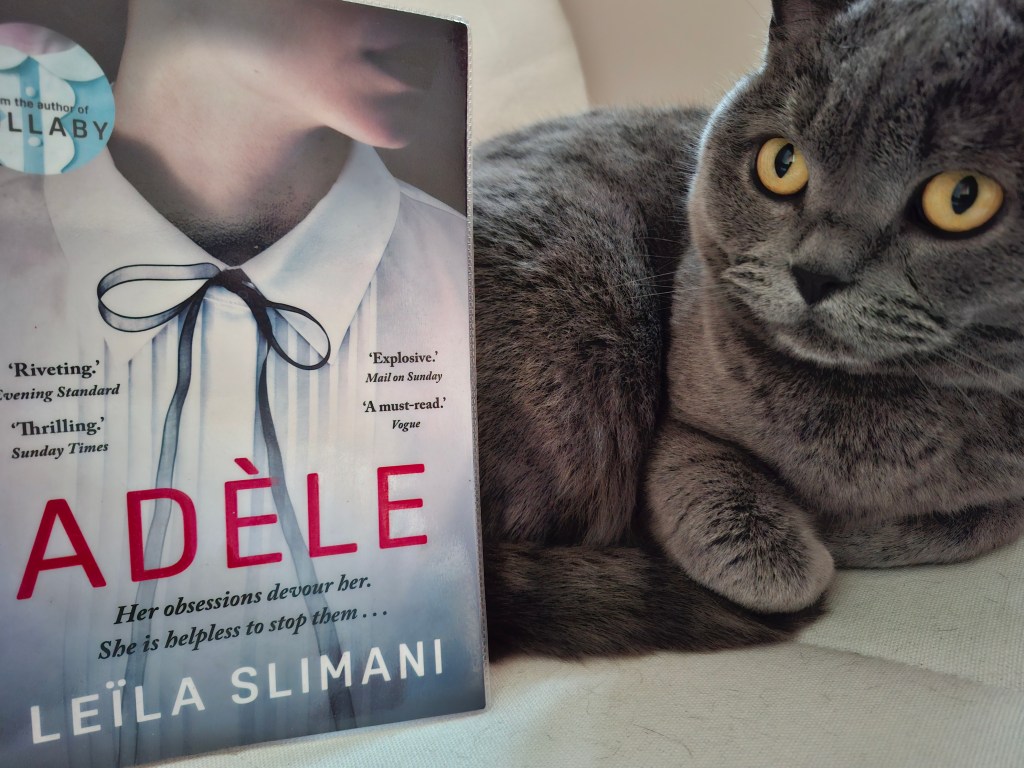
Adèle
Leïla Slimani
The next ten books I plan to read will be in aid of a ‘Read around the World’ challenge one of my students has set up. She’s selected 10 countries at random and is encouraging everyone in the school community to read one book from each by Christmas. I can’t resist a challenge (particularly not when it relates to books) and I approve of the sentiment behind this one, so obviously I’m taking part.
I’m conscious, however, that reading the books is going to be the easy part. Finding them is a whole other matter. Because I read so many books, and very seldom re-read anything, I typically get my reading material from my local library. If I didn’t, I’d be bankrupt and knee-deep in books. But my local library, marvellous as it is, isn’t exactly brimming with international fiction.
It was, however, able to provide me with Adèle by Leïla Slimani, which I selected so that I could tick Morocco off my list, having been informed by the internet that Slimani was born and grew up there. Somewhat to my perturbation, this book is set in France, which is also a country on the list. Rightly, then, it ought to be my France book. But novels from Morocco were much more difficult to locate, so I’m afraid it remains my Moroccan offering, despite the fact I learnt nothing about Morocco from reading it. This is acceptable within the rules of the competition but has thrown me into a conundrum of classification. Is authorial origin really enough to define a novel as ‘from’ one country or another?
I could have dwelt on this question forever and been no closer to a satisfactory answer. Instead, I read the book.
It was an unsettling experience, in the best possible way. The novel is about a woman for whom ‘eroticism’ has become an obsession – the only thing that ‘masked the banality and vanity of things’. Eroticism is her word. It does not always seem apt; some of her encounters seem sadder, some more violent, than that description allows.
Yet, even as could not help but put those quotation marks around the word eroticism, I felt guilty for doing so. Perhaps because its prose is sparse, I felt this novel was asking me to reserve my judgement. I know I said only in my last post that I disliked minimalist prose, but already I feel the need to take that back – here, it absolutely serves a purpose. It keeps the reader at a distance, keeping Adèle a mysterious character.
We learn little of her motivation, and what little we learn does not permit us to draw conclusions. Even Adèle herself cannot decide whether she wishes to celebrate or condone her choices. At one point, she describes her sexual conquests as ‘her greatest act of defiance’; elsewhere, she expresses shame. This is, then, a novel that asks its readers to take its protagonist on her own terms and to surrender to the moral ambiguity of a complex human life. Having read it, I feel slightly unmoored, slightly less certain – just the way I like books to make me feel.


Leave a comment