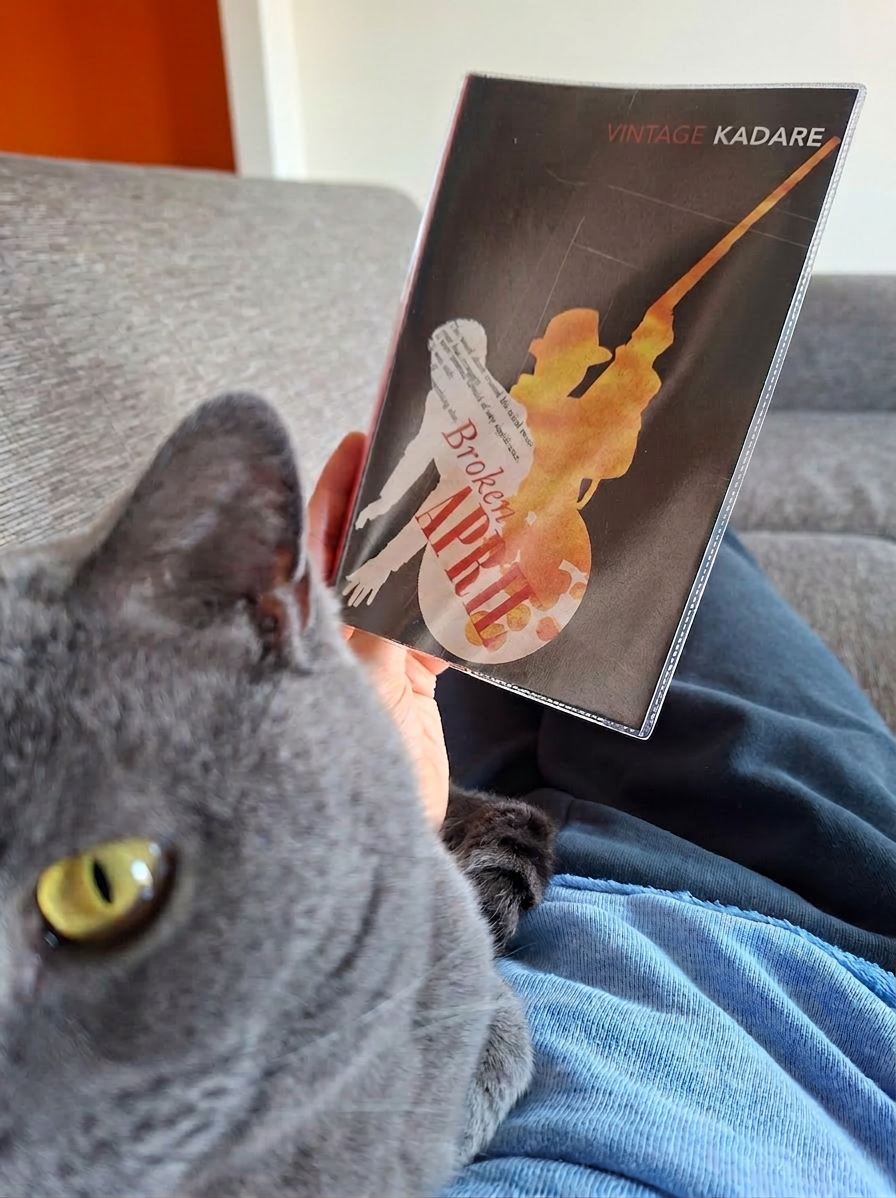
Broken April
Ismail Kadare
In terms of my Reading around the World challenge, this book was rather satisfying – it is a book written by an Albanian author that is very much about Albania. Specifically, it is set in northern Albania, in the High Plateau, and it explores the Kanun, or Code, that rules life there. I confess I had to do a bit of quick fact-checking before writing those sentences. Even as I was thinking, ‘this is a book about Albania’, I recalled that this was a work of fiction and, to that end, could be entirely fantastical. It isn’t (at least not completely) – the Kanun is a thing. So I feel I’ve learnt something about Albania that I didn’t know before.
But before I get too smug, I have to say that this is also a book that warns us that our knowledge of any other culture may not be as good as we think it is. This is in some part a novel about the way we interact with other cultures. (This, for me, makes it an even more satisfying novel to have selected for a challenge based on reading books from other cultures). At least, in my reading, that’s what the book is primarily about. I’m conscious that my approach might not be the only one. The book presents us with three different narratives, which overlap: first, there is the story of Gjorg, a man at the centre of a blood-feud; second, we have Bessian and Diana, a newly-married couple visiting the High Plateau on their honeymoon, and thirdly (albeit more briefly) we see events through the eyes of the Steward of the Blood.
For my part, it was when I first encountered Bessian and Diana that I thought ‘now this gets interesting!’ Bessian is an author who has written about the High Plateau, and who is at one point admonished for looking there for ‘exalted themes’ and ‘beauty so as to feed your art’. This is obviously ironic, as Broken April could be seen to be doing the exact same thing.
I love this kind of playfulness; the narrative of Bessian and Diana made me smile, and it made me like the book. But this is not the only story, and it is perhaps not meant to be the most important one. The fact that Gjorg’s story begins and ends the novel suggests that it should perhaps be the most privileged. If taken as such, the book takes on a different hue. But it wasn’t the shade I saw; I leave it to a different reader to explore it.


Leave a comment