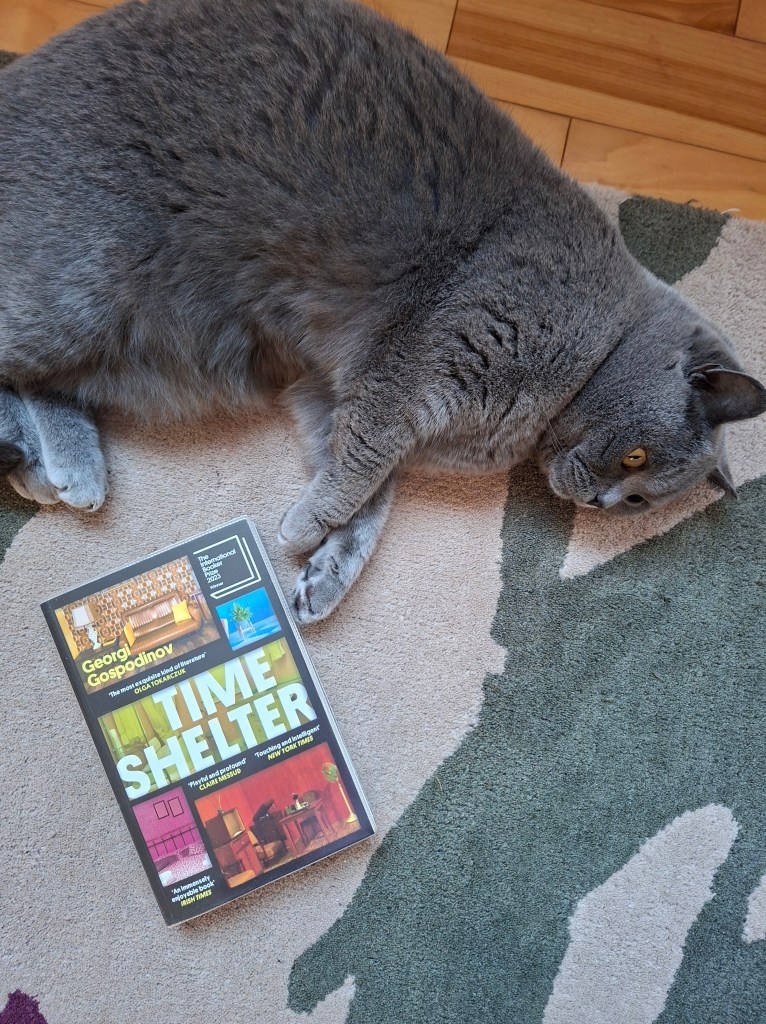
Time Shelter
Georgi Gospodinov
Just from the epigraphs (yes, epigraphs plural – there are 11 of them), I knew this would be an intense read. I admit I began it, managed about 10 minutes, realised I had no idea what was going on, decided to try again the next day and put it down. This was a good decision: the next day all made perfect sense and I discovered I rather liked this book. The ‘time shelters’ of the title are, in the first place at least, clinics set up for patients with Alzheimer’s; they contain rooms dedicated to past decades, allowing those whose memory is failing to return to a period in time in which they feel comfortable and safe.
This affords the narrator many an opportunity to reflect on the nature of time and the past. For example, her asks ‘can you make anything else out of past beside past? Could it be recycled into some kind of future, albeit secondhand?’ I began to realise that the joy of this book would most likely not lie in its plot, but in its wordplay and philosophising. Not long after I had this thought, I came across a sentence in which the narrator speaks explicitly of ‘language games’ and suggests they might ‘hint at more than we think’. This, to me, confirmed my hypothesis and made me feel rather pleased (I do like it when a book seems to be telling me I’ve got it right). I settled in to enjoy these ‘language games’ and to allow my brain to ponder them.
But as the novel progressed, things began to feel more sombre. Where at the start I’d found light-heartedness, now I found seriousness. And I wasn’t sure I liked it. I kept wondering where the earlier playfulness had gone and hoping for its return. When it remained absent, I began to wonder if it ever had been as fun as I’d thought (a rather apt concern, given that this is a book about losing one’s memory). By the end, it all felt a bit too gloomy for my liking. Not that I don’t like a gloomy book from time to time, but I felt oddly betrayed by this one. Its light-hearted beginning had drawn me in only for the novel to break the contract it had made. It became something else and on this occasion I didn’t like that. Most likely, this was because of the work I’d had to put in at the start – had it been easy from the get-go, I might have objected less to the shift; having had to concentrate at the beginning, I’d run out of energy to adapt. Change ain’t easy.


Leave a comment