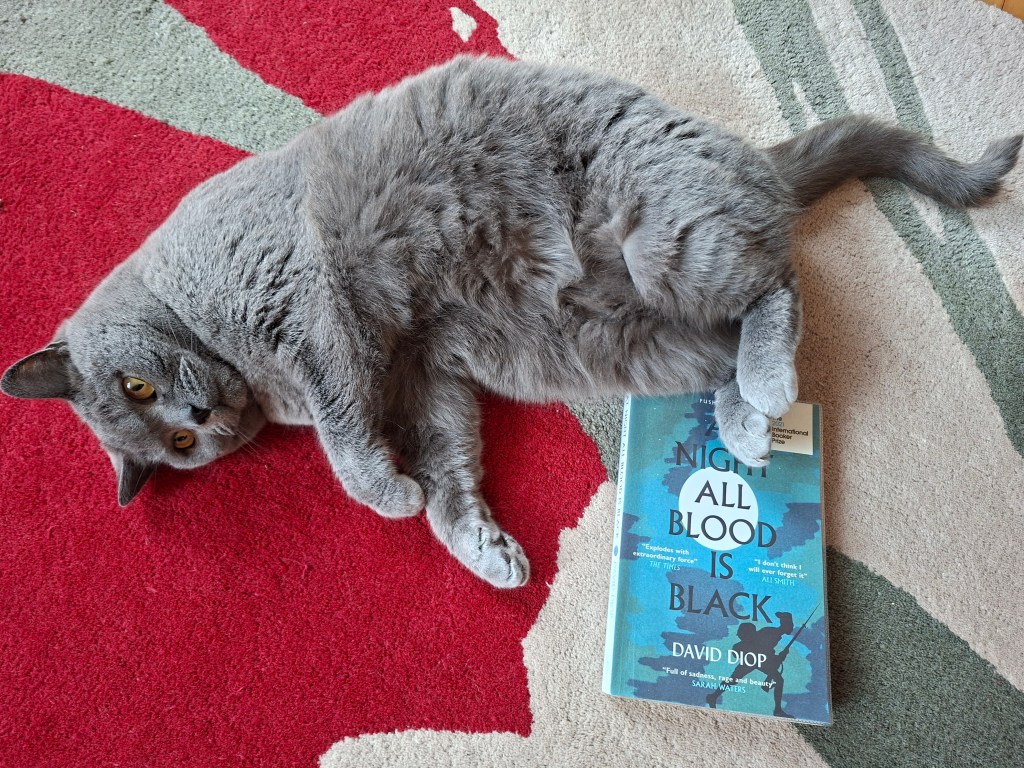
At Night all Blood is Black
David Diop
I read this book almost entirely in a single sitting. It’s the kind of book I find hard to put down. Firstly, it’s short, so the end was always clearly in sight. Secondly, the prose has a lilt to it that carried me along. It repeats phrases such as ‘I knew, I understood’ over and again. I realise that sounds potentially annoying, and I did wonder at first if it might become so, but I found that these phrases developed a mantra-like quality – there was something soothing, perhaps almost hypnotic, about them.
The novel uses repetition structurally, too. The narrator, who is a Senegalese solider fighting for France in the Great War, returns time and again to just a few events. Thus, the novel’s structure is an iterative one, with the reader learning a little more about what has taken place each time the narrator returns to re-examine it. This kept me hooked, both because I wanted to know more, but also because of the sense it gave of the extent to which the narrator is haunted by his memories.
Coming to the end of a novel that has gripped me in this way is, I find, a peculiar experience. I finished the last page and could think only ‘oh’. With some novels, I’m itching to get writing, but on this occasion I simply sat for a while—it felt like I needed to re-emerge gradually back into the present—and at first I couldn’t imagine what I was going to write here (I’m composing this an entire day later). Looking back, that ‘oh’ was an ‘oh’ of moral uncertainty, of not knowing how to balance something that felt it ought to be contradictory. This novel tells of grotesque and gruesome acts, and its narrator is often indignant, frequently angry and sometimes almost monstrous in his behaviour, and yet this book is not grotesque or monstrous or angry – more than anything, to me, it felt very sad.


Leave a comment