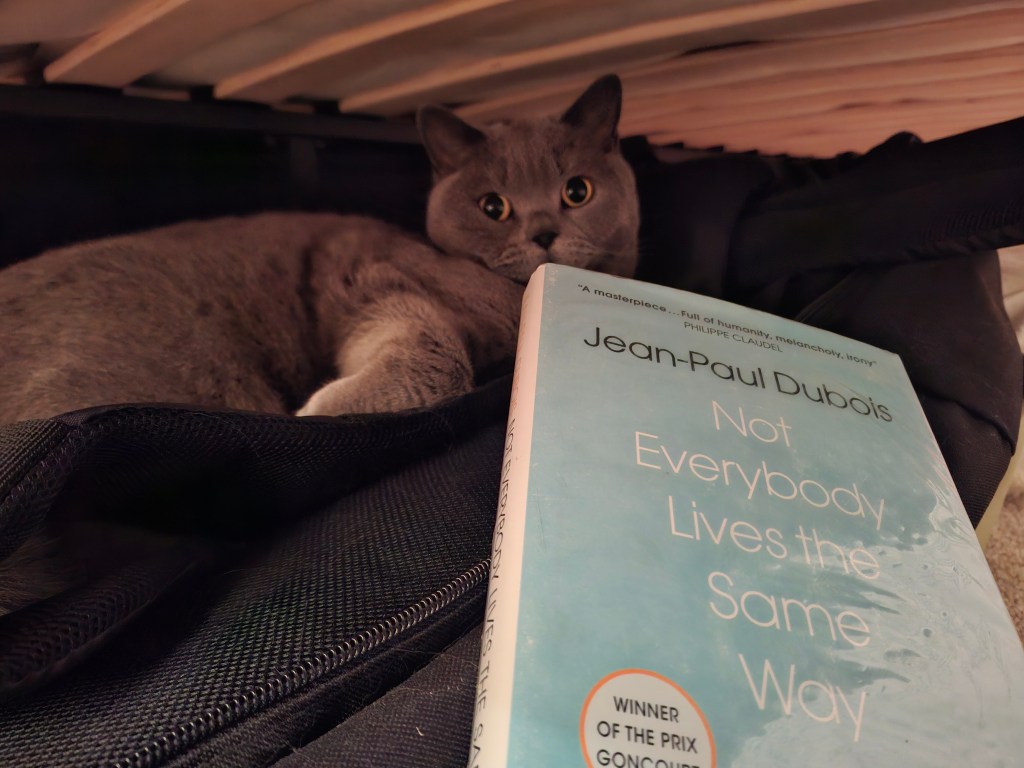
Not Everybody Lives the Same Way
Jean-Paul Dubois
My experience of this novel was a peculiar one. For most of its pages, I felt indifferent to it. I found it difficult to pick up and easy to put down. I couldn’t muster any great interest in its plot or feel any attachment to its narrator.
And then today I read the final two chapters. I picked it up with a feeling of trepidation: finishing it would mean having to compose this account, and I couldn’t think what on earth I might say. Of course, before I got to that point, I needed to actually make it to the end. So I began to read… And I loved it. From the very first sentence of the penultimate chapter, I could finally see why this novel won the Prix Goncourt. I finally understood the reviewer quotes that, on its cover that describe it as “a cocktail of humour, intelligence and sentiment” and “full of humanity, melancholy, irony”.
Truly, I realised, my earlier indifference was a reflection of me, not of the novel. It had been a long week, with little time to read, and during my brief reading stints my mind had been elsewhere. It was only now, at the end of the weekend, that I had headspace enough to appreciate this novel’s charm.
That said, my last-minute change of heart does bear some relationship to the type of novel this is. Paul Hansen, its narrator, recounts his story from a prison cell and the question that the reader therefore asks from the start is why. How did he come to be there? It is clear that this answer will be given only at the end; the book builds to this ‘reveal’ and its success therefore hinges on its quality. Clearly, for me, it did a good job.
But an ending is not everything. I don’t usually re-read novels (too many books, too little time!) but I feel I maybe owe this one a second reading.


Leave a comment