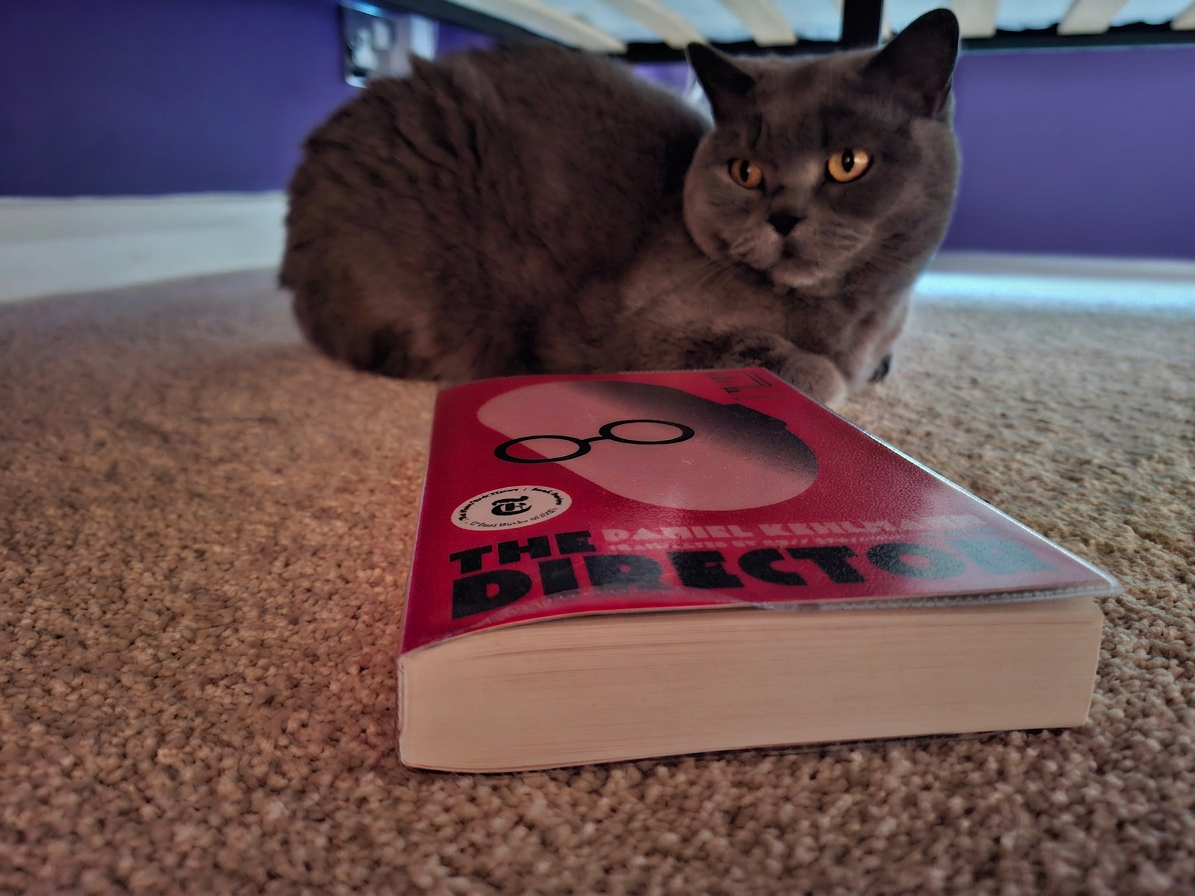
The Director is based on the real-life Austrian film director and screenwriter G.W Pabst; the story is, however, entirely fictional and is an imaginative account of the time Pabst spent in the USA and then in Nazi-occupied Austria at the outbreak of and during World War II. In common with many books written about this period, this novel explores how people came to be complicit with the Nazi regime. As one character neatly summarises “People were many things before the war, and then they were something completely different. I’m telling you, it’s all mixed up and jumbled”. Although this is an oft-explored theme, this book navigates it in a way that was, to me, subtle and nuanced. I was especially struck by a section where Trude, Pabst’s wife, is at a book club that is discussing a novel by a Nazi-approved author. The narration records an assortment of voices she hears inside her head. One baulks at the book that has been chosen; another urges her to play along, telling her “when you live in hell, you need friends and allies”.
For both Trude and for Pabst’s son Jakob, complying with the Nazi regime is a matter of self-preservation, at least in part – both characters are complex and I’d hate to over-simplify them. Pabst, though, is an even more complicated figure and his motives are far from straightforward. He was thus, to me, a fascinating (albeit far from likeable) character. Pabst is, more than anything, obsessed with film-making (to the point where, in one passage I especially enjoyed, he starts seeing his own experience, as he lives it, in filmic terms). For Pabst, nothing matters but the film – he is blind to almost everything else.
This blindness is amplified by a second feature that this book has in common with many novels that revolve around the holocaust (although again this novel employs it with particular skill): it makes use of the fact that the reader knows this historical period well to create irony – the reader knows more than the characters do and sees what they do not, or at the very least sees it sooner. It can often feel as though we’re one step ahead of Pabst in terms of understanding. Then again, the book kept me wondering. What is the extent and depth of Pabst’s blindness? Is it wilful? Is it feigned? It all made for a compellingly ambiguous portrait.


Leave a comment