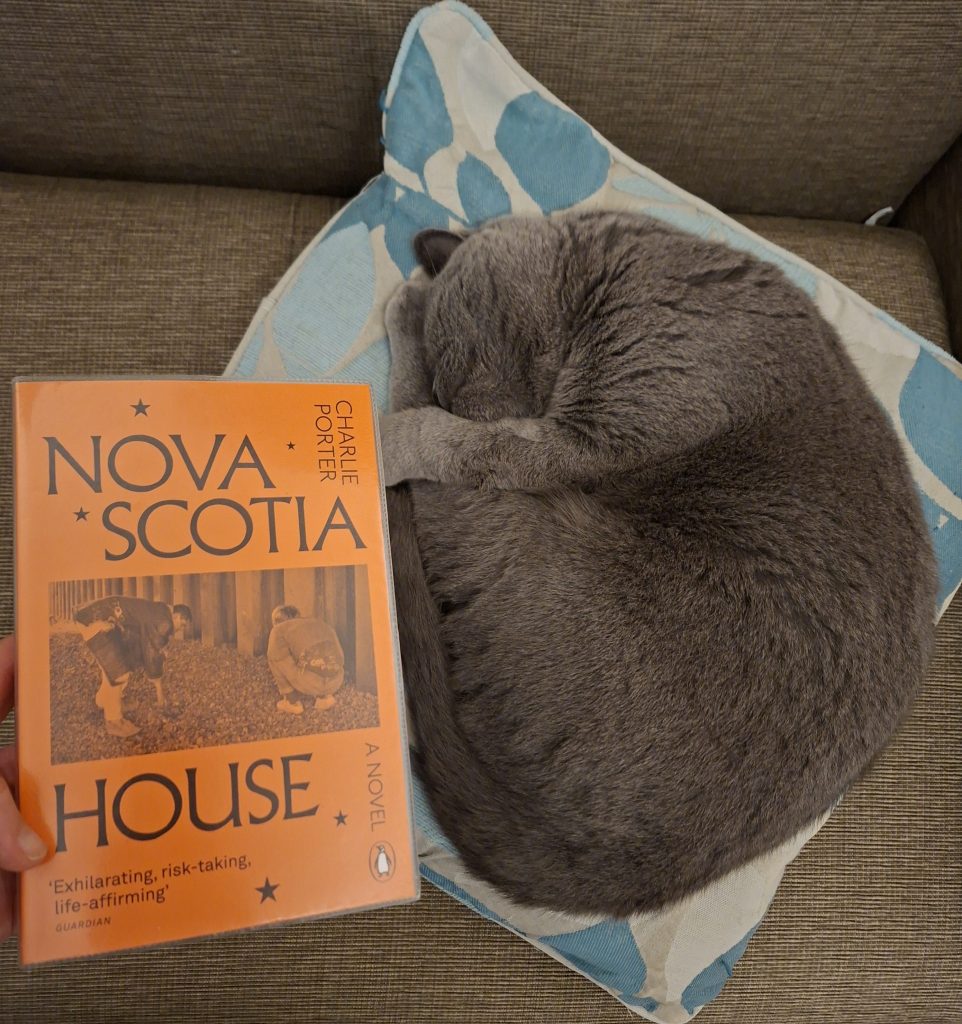
Nova Scotia House
Charlie Porter
I was worried, at first, that I wasn’t going to get along with this book. Specifically, I didn’t think I could get along with its punctuation. Its approach is non-standard and it has good reasons for it; the inventive punctuation (along with non-standard grammar) fits perfectly with the book’s theme: non-conformity. I find, however, that in the absence of full stops I find myself reading at full pelt, unable to take a mental breath. By the time I closed the book on the first evening I read it, at the end of a passage that was thin on full stops, I felt exhausted.
Fortunately, when I returned to the book the next day, there were (to my mind) a more acceptable number of full stops, and I began to appreciate this novel more. It tells the story of Johnny and Jerry, gay men living together in the 80s and 90s. Johnny, Jerry and their friends are in search of a culture that breaks away from norms – not just heterosexual ones, but those of capitalism, monogamy, societal expectation and class. The book contains jubilant descriptions of parties, sexual encounters and the cultivation of vegetables (yes, this book really is also about the joys of growing veg).
But it’s not all fun; the book also captures the discrimination and hypocrisy of its era. One character comments, with delightfully crude language, that ‘an MP would be sucking me off one minute and then next minute he would be back in the chamber casting his millionth vote against the vile sin of homo-sex-ual-it-y. His mouth full of my spunk and then he’s running off to jolly well make sure we all remained repressed’.
Most strikingly, though, it paints a picture of an era of grief and mourning, as the HIV epidemic takes hold. The book highlights the way in which the suffering of the sick and the sadness of the bereaved is made more devastating by the fact that ‘no one cared and Jerry, every one sick, everyone affected, was expected to just deal with it’. This novel is a powerful reminder that ‘we cannot forget the nightmare’.


Leave a comment