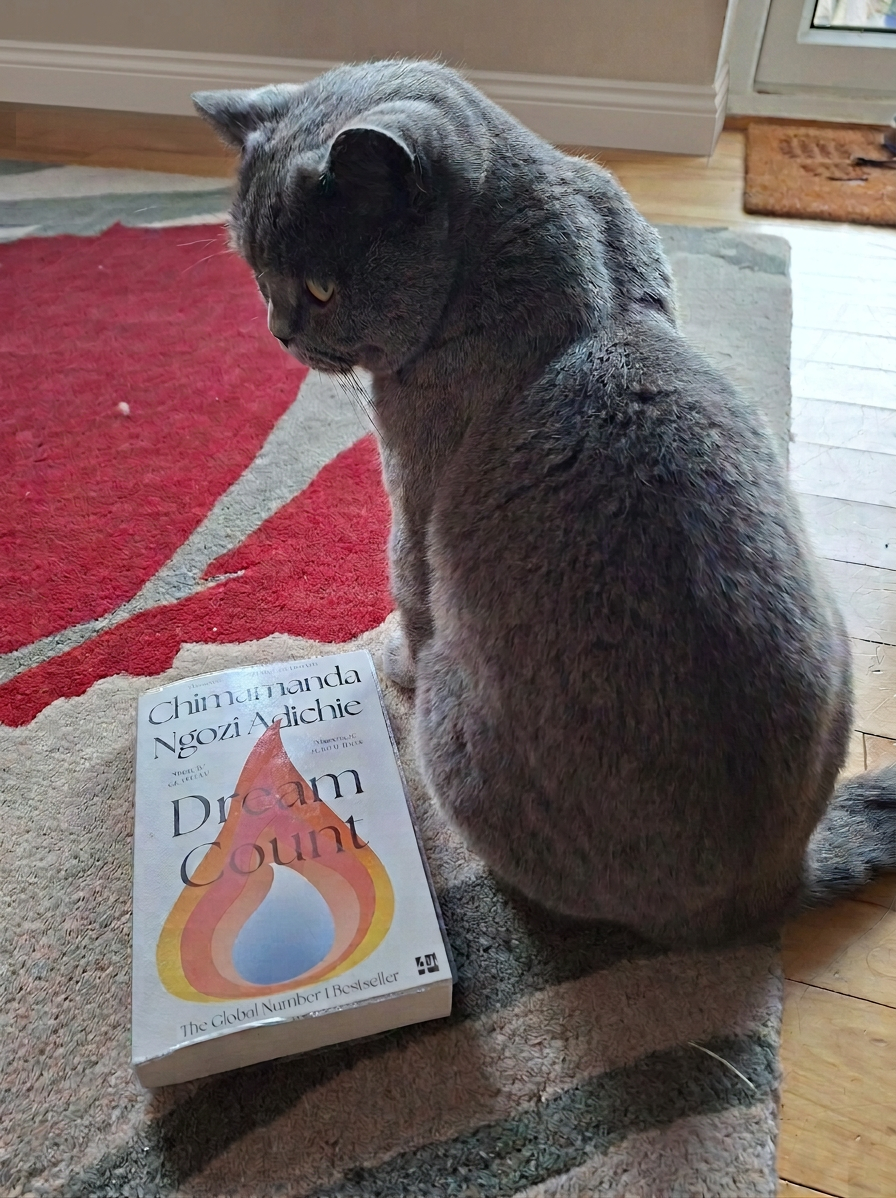
Dream Count
Chimamanda Ngozi Adichie
I finished this book a couple of days ago, but it’s taken me until now to write a review of it. You see, it’s left me puzzled. The novel tells the story of four women and their relationships both with men and each other. It is set during lockdown and Chia, the novel’s narrator, tells us that ‘it was during lockdown that I began to sift through my life and give names to things long unnamed’ before looking back at each of her past relationships with men and reflecting on where each one went wrong. I found the opening of the novel striking; Chia’s reflections on lockdown, and on the project she has decided to undertake, drew me into the novel; for example, she tells us that ‘the clarity of hindsight is bewildering. If only we could see our failings while we are still failing’. Her tone intrigued me.
As I read on, I discovered that the novel has five sections. Each of the first four sections focuses on a different woman; the fifth returns to Chia, with whom the novel began. However, only Chia’s sections are narrated in the first person, so in some way her perspective dominates throughout. Nonetheless, the use of the different sections is effective. It allows the story to unravel piecemeal – a throwaway remark in one section becomes central to the narrative of the next. Thus, intrigue is created. Moreover, it forces us to shift out judgements. The opinions expressed by the women about each other are often undercut by their full stories; we understand each character differently when her motivations and emotions are at the forefront of the narrative.
So in a way it’s a book that’s meant to leave one puzzled – it invites questioning and reinterpretation. By contrast, the characters are frequently vehement in their opinions. And I couldn’t help but wonder whether some of those opinions were also ones that the novel itself wished to promote. For example, at one moment, the characters are talking and one asserts that ‘every woman has a story like this, where a man has lied to her and left her with consequences’. Omelogor insists that, for her, this isn’t true; she says ‘I guess I’ve just been lucky to be with mostly good men’. Immediately after this, however, the novel narrates her relationship with a ‘bad’ man, thus suggesting that the initial statement is true. This left me wondering: does the novel really want to promote the idea that a lying man lies at the source of all women’s woes? Would that not be a bit too simplistic? Surely Adiche’s feminism is more nuanced that that?
I fear that, in expressing these concerns, I’m nitpicking and fixating too much on one small moment. Taken as a whole, the novel is far from simplistic. Omelogor and Chia, in particular, are outspoken characters and far from perfect. They are, at times, not wholly likeable. The reader is thus left to infer that the problems their relationships face are as much to do with them as they are with the men that they date. Nonetheless, the questions above continue to niggle me.


Leave a comment